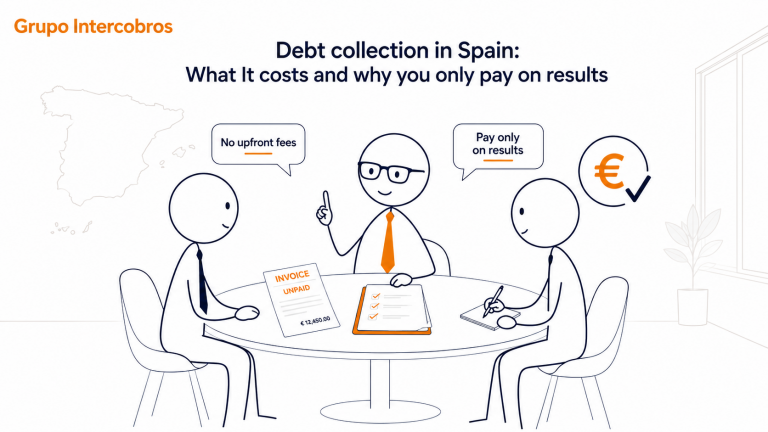
Debt collection cost in Spain. For a foreign creditor, recovering an unpaid invoice in Spain should cost nothing unless the money actually comes back. The dominant model in Spanish B2B commercial recovery is success-based: a percentage of what is genuinely collected, with no retainer, no opening fee and no charge per letter or call. If the file produces nothing, you pay nothing.
That structure exists for a reason. Extrajudicial recovery — negotiation with the debtor, without courts — resolves the overwhelming majority of commercial files. It is fast, it preserves the commercial relationship where one is worth preserving, and it carries no fixed cost for the creditor. Litigation is the exception, not the route.
This guide explains what debt collection actually costs in Spain: how the success-based model works, what drives the percentage, what you can charge back to the debtor, and what the internal alternative really costs you. The wider Iberian picture is in our guide to debt collection in Spain and Portugal.
Key facts at a glance : Debt collection cost in Spain
- Model: success-based fees in extrajudicial recovery — no recovery, no fee.
- No retainers, no opening fees, no cost per action.
- Portfolio assessment: free and without obligation, before anything is agreed.
- Statutory late payment interest: ECB main refinancing rate plus eight percentage points.
- Recovery costs allowance: a fixed 40 euros, chargeable to the debtor automatically.
- Interest accrual: automatic from the day after due date, with no reminder required.
- Legal framework: Ley 3/2004, implementing the EU Late Payment Directive.
- Main cost drivers: age of the debt, debtor country, portfolio volume, documentation quality.
What does “no recovery, no fee” actually mean?
It means the provider carries the risk of the file, not you. The agency invests its own time, its own collectors and its own systems, and is paid only out of money that reaches your account. If the debtor never pays, the agency has worked for nothing and you owe nothing.
That alignment matters more than it sounds. Under a retainer or fee-per-action model, a provider is paid whether or not a file goes anywhere — so there is no economic pressure to distinguish a recoverable claim from an unrecoverable one. Under a success model, the provider has exactly the same interest as you do in only pursuing what can actually be collected.
What to verify before signing anything
“No win, no fee” is used loosely in the market. Four questions separate a genuine model from a marketed one:
- Are there any fixed charges at all? Opening fees, file-handling fees, administration charges and monthly minimums all break the principle. Ask specifically.
- What is the percentage calculated on? Principal only, or principal plus recovered interest and costs.
- What happens if the debtor pays you directly? This is normal once pressure works. The contract should say clearly how it is treated.
- Is anything charged for a file that fails? Under a genuine model, nothing — including files that are assessed and then declined.
Grupo Intercobros works exclusively on success-based fees in extrajudicial recovery: no retainers, no opening fees, no cost per action, and no charge on a file that produces nothing.
The assessment costs nothing either
Before any engagement, we analyse the portfolio and tell you what we consider recoverable and what we do not. That assessment is free and carries no obligation. If we believe a file will not produce a recovery, we say so rather than take it on — which, under a success model, is as much in our interest as in yours.
What determines the percentage?
There is no single market rate in Spain, and any provider quoting one before seeing your file is quoting a marketing number rather than a price. Five variables genuinely move the figure.
- Age of the debt. The strongest driver by far. A file thirty days past due and a file eighteen months past due are not the same product. Recovery probability falls sharply with time, and pricing reflects that reality.
- The debtor's country. Recovering in Spain, Portugal, France or Italy involves different legal frameworks, different procedural conditions and different negotiating cultures. A single flat percentage across all four markets would be a fiction in at least three of them.
- Portfolio volume. A batch of forty invoices carries different unit economics from a single isolated claim.
- Documentation quality. A file with a coherent chain — order, delivery note, proof of delivery, invoice — moves faster and succeeds more often than one built on partial evidence.
- Debtor profile. A trading company with visible activity is a different proposition from a dormant entity that has stopped filing accounts.
This is why a serious provider prices after seeing the portfolio, not before. A percentage quoted blind tells you nothing about what the service will cost you, because under a success model the variable that decides your actual outlay is whether anything is recovered at all.
What you can charge back to the debtor
Under Ley 3/2004, a substantial part of your recovery cost is legally chargeable to the debtor — and most foreign creditors never claim it, which is money left on the table in every single file.
Late payment interest
In commercial transactions between undertakings, interest accrues automatically from the day after the due date. No reminder, no formal notice and no demand letter is required to start the clock. Many exporters believe they must first “put the debtor on notice”. They do not.
The statutory rate is the European Central Bank's main refinancing rate plus eight percentage points, published semi-annually in the official gazette. On a materially overdue balance this is not a rounding error: on a substantial invoice outstanding for a year, accrued interest can approach or exceed what a success-based fee would cost you.
The 40-euro recovery costs allowance
Where the debtor is in default, the creditor is entitled to a fixed 40 euros in compensation for recovery costs. The law is explicit that this is added to the principal in all cases and without any express request. Additional compensation may be claimed for recovery costs exceeding that amount.
Payment terms
Where no term is agreed, interest accrues 30 days after receipt of the invoice or delivery of the goods or services. Agreed terms should not, as a general rule, exceed 60 days, and terms designed to defeat these limits can be set aside.
Why this changes the negotiation
A properly constructed demand claims principal, accrued statutory interest and the recovery costs allowance together, with the legislation cited expressly. This does two things.
It increases what you recover. And it changes the debtor's arithmetic: the conversation stops being about whether to pay and starts being about how fast the cost of not paying is growing. A demand claiming only the principal quietly tells the debtor that delay is free.
Why extrajudicial recovery is the cheapest route
Negotiation is not a soft alternative to enforcement. In commercial debt it is the route that works, and it is the one with no fixed cost to the creditor.
It works for a structural reason. A company under cash-flow pressure does not stop paying everyone — it ranks its creditors and pays the ones it cannot afford to lose and the ones applying credible, sustained pressure. Professional extrajudicial collection works directly on that ranking until you move up it.
What the process involves
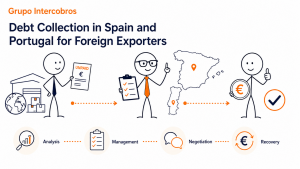
- File analysis. Document verification, age of the debt, registry status and apparent solvency. Before calling, you need to know who you are calling and with what real margin.
- Locating the decision-maker. Whoever answers the phone is rarely the person who decides on payment. Identifying the real one is half the work.
- Formal demand. Principal, accrued interest and recovery costs, with the applicable legislation cited expressly.
- Negotiation. Escalating, sustained contact in the debtor's own language. The objective is a dated commitment, not a vague promise.
- Settlement. Single payment or documented instalment plan, with written acknowledgement of debt where appropriate.
- Monitoring. An unsupervised agreement is a postponed default. Every instalment is tracked and every breach reactivated immediately.
The language point
The operational difference is who makes the call. Correspondence in English from another country is easy for a Spanish debtor to file away. A collector working in the debtor's own language, familiar with local commercial practice, removes the excuse entirely.
Grupo Intercobros works with in-house, native collectors wherever the debtor is located — Spain, Portugal, France and Italy. Not a correspondent network passing files down a chain where information degrades at every handover, but people negotiating in that market every day and accountable for the outcome.
What outcome is realistic
Across the B2B portfolios we manage in Portugal, the out-of-court recovery rate stands at 77%. That is proprietary Grupo Intercobros data covering business-to-business files handled at the amicable stage. It is not a sector average and not a guarantee: outcomes depend on the age of the debt, the debtor's real solvency and the quality of the documentation.
The cost nobody puts in the spreadsheet
When exporters compare outsourcing against handling recovery internally, they almost always compare against zero. Internal collection feels free because no invoice arrives for it.
It is not free. The real internal cost of chasing a foreign debtor includes:
- Staff time. Calls across time zones, translated emails, escalation meetings, chasing the chaser. Multiply an hourly cost by the months a file typically drags on before anyone admits it is stuck.
- Opportunity cost. The same finance people are not doing forecasting, credit control, or collections on files that would actually respond.
- Falling recovery probability. Every month of unsuccessful internal chasing reduces the chance of ever collecting. This is the expensive one, and it never appears in any budget line.
- Financing cost. Money owed to you is money you are lending your customer interest-free while paying for your own working capital.
- Precedent. If one customer in a market learns that late payment carries no consequence, others in the same sector often learn it too.
A success-based fee on money actually recovered is measurable and conditional. The cost of a file that quietly ages into worthlessness is neither — which is exactly why it gets ignored.
Is this file worth pursuing? A practical test
Not every invoice justifies action, and a provider who takes on everything is not doing you a favour. Four questions settle it in most cases:
- Does the debtor exist and trade? The Spanish commercial registry shows whether the entity is active, dissolved or struck off, and whether it files accounts. A company that has stopped filing is a warning in itself.
- Is there anything to recover against? Pressure only works on a business with something to lose.
- Is the documentation coherent? Order, delivery note, proof of delivery and invoice must match. Inconsistency is what a debtor builds a defence on.
- Is there aggregated volume? A single small invoice may not justify action alone; several files against the same debtor, or a batch across a market, usually do.
Under a success-based model this assessment costs you nothing, which is the point. You should know whether a file is viable before deciding anything about it.
If negotiation does not work: the judicial option
Extrajudicial recovery resolves most commercial files, but not all. Where a debtor has the means and simply refuses, litigation remains available — as an escalation you decide on, not as a default route.
Two things are worth knowing about it in Spain.
First, companies no longer pay a court fee to bring a civil claim. Court fees for legal persons accessing civil jurisdiction were declared unconstitutional and void by Constitutional Court judgment 140/2016, on the grounds that the amounts were disproportionate and infringed the constitutional right of access to justice. Individuals had already been exempted in 2015. The barrier to entry is therefore professional fees and enforcement costs, not a state levy.
Second, the amicable phase is what makes a judicial claim winnable. A debtor who has acknowledged the debt in writing, or accepted and then breached a payment schedule, has very little room to sustain a credible defence. That evidence is built during negotiation. Litigation launched cold, without it, is slower, more contested and more expensive.
Judicial recovery has a different cost structure from extrajudicial, since professional representation and enforcement costs come into play. Nothing escalates without your decision, and the structure is explained and agreed before anything moves.
How we work
We are a B2B extrajudicial debt recovery firm headquartered in Madrid, with offices in Barcelona and Seville, operating directly in Spain, Portugal, France and Italy.
Amicable recovery first, always
We exhaust negotiation before recommending anything else. It is faster, it costs the creditor nothing unless it works, and it builds the file that would make a later claim strong if one becomes necessary.
Success-based fees
We charge only if we recover. No retainers. No opening fees. No cost per letter or call. The percentage is assessed case by case, according to the debtor's country and the characteristics of the portfolio — which is why we look at the file before pricing it.
Full visibility on what you are paying for
Our Client Area shows, in real time, the status of every file, every action taken with its date and outcome, the stage each claim has reached, the amounts recovered against the amounts outstanding, and all associated documentation. It is available through any browser and as an iOS and Android application.
For a foreign creditor this matters more than for a domestic one. When the process happens in another country, in another language, before institutions you do not know, visibility is what replaces control. You are not waiting for a monthly update — you look when you want to, from wherever you are.
It also removes follow-up entirely: your finance team stops spending time asking how a file is going, because they simply check.
A named account manager
Above the platform sits your assigned client account manager: one consistent point of contact linking your company to the collections team, handling everything the platform does not cover. You are not passed from hand to hand or asked to repeat your history on every call. For larger portfolios, they coordinate regular review meetings with your teams.
The full country scope is on our international debt collection page, and the process step by step on how it works.
Frequently asked questions
Do I pay anything if the debt is not recovered?
No. In extrajudicial recovery Grupo Intercobros charges only on amounts actually collected, with no retainers, no opening fees and no cost per action. If the file produces nothing, nothing is charged. It is worth confirming this explicitly with any provider, since some combine a success percentage with administration charges.
How much does a debt collection agency charge in Spain?
The dominant model in Spanish B2B commercial recovery is success-based fees: a percentage of what is actually recovered. There is no single market rate, because the percentage depends on the age of the debt, the debtor's country, the portfolio volume and the quality of the documentation. Any figure quoted before the file has been reviewed is a marketing number rather than a price.
Does the portfolio assessment cost anything?
No. The portfolio is analysed free of charge and without obligation before any engagement, and you are told frankly what is considered recoverable and what is not. Files judged unlikely to produce a recovery are declined rather than taken on.
What interest can I charge a Spanish debtor?
In commercial transactions, late payment interest accrues automatically from the day after the due date, without any reminder being required, under Ley 3/2004. The statutory rate is the European Central Bank main refinancing rate plus eight percentage points, published semi-annually in the official gazette.
Can I claim my recovery costs from the debtor?
Yes. Where the debtor is in default, a fixed 40 euros is due as compensation for recovery costs, added to the principal in all cases and without express request. Additional compensation may be claimed for recovery costs exceeding that amount.
Is it cheaper to chase the debt in-house?
Rarely, once the full cost is counted. Internal chasing consumes staff time across time zones and languages, diverts finance resources from work that would produce a return, and reduces recovery probability with every month that passes. The last of those is the largest cost and the one that never appears in a budget.
What happens if negotiation does not work?
Litigation remains available as an escalation, decided by you rather than applied automatically. It carries a different cost structure, since professional representation and enforcement costs come into play, and this is explained and agreed before anything moves. In Spain, companies no longer pay a court fee to access civil jurisdiction following Constitutional Court judgment 140/2016.
Is there a minimum amount you will handle?
What matters is the portfolio rather than the individual invoice. Where several files relate to the same debtor, or there is an aggregated volume of unpaid invoices, recovery is fully viable. The whole portfolio is assessed before a strategy is recommended.
How do I know what is being done for the fee?
Through the Client Area, which shows in real time every action taken on every file with its date and outcome, the stage reached and the amounts recovered. It is available through any browser and as an iOS and Android app, and you also have an assigned account manager as a single point of contact.
Do the same fee principles apply in Portugal, France and Italy?
Yes. We work on success-based fees across all four markets, with in-house native collectors in each. The percentage differs by country because the legal frameworks, procedural conditions and negotiating environments differ.
Sources and legislation
- Ley 3/2004 — measures against late payment in commercial transactions, Boletín Oficial del Estado.
- Constitutional Court judgment 140/2016 — annulment of court fees for legal persons, Boletín Oficial del Estado.
- Decreto-Lei n.º 62/2013 — late payment in commercial transactions, Portugal.
- Court fees in Portugal — European e-Justice Portal.
Find out what your portfolio is worth before you commit to anything
The only way to know what recovery will cost you is to know what is recoverable. We analyse your portfolio free of charge and without obligation, and tell you frankly what can be collected, on what timescale and with what strategy. If we believe something cannot be recovered, we will say so.
From there, success-based fees: we charge only if we recover. No retainers, no opening fees, no cost per action. Plus an assigned client account manager and full real-time visibility through the Client Area.
Timing is the single variable that moves the outcome most. The sooner a file reaches us, the more of it comes back.
Submit your case through our contact form — you are welcome to write to us in English.