Foreign companies exporting to Spain and Portugal can recover unpaid invoices without travelling, without opening a local entity and, in most cases, without going to court. Both countries apply the same European framework on late payment in commercial transactions, and both offer fast, low-cost judicial instruments that most foreign creditors never hear about.
The difficulty is rarely legal. It is operational. An exporter in Rotterdam, Manchester or Hamburg sends reminders in English to a debtor who reads them in Spanish or Portuguese, posts a registered letter to a head office that moved two years ago, and eventually writes the invoice off. Meanwhile the debtor keeps trading and keeps paying other suppliers.
This guide explains how debt collection in Spain and Portugal actually works: statutory payment terms, the interest you are entitled to claim, the judicial routes in each country, when escalation makes sense, and how to keep visibility over a recovery process happening in a language and a legal system you do not know.
Key facts at a glance
- Spanish framework: Ley 3/2004, implementing the EU Late Payment Directive.
- Portuguese framework: Decreto-Lei n.º 62/2013, implementing Directive 2011/7/EU.
- Default payment term: 30 days from receipt of the invoice where nothing is agreed, in both countries.
- Maximum agreed term: 60 days as a general rule in both jurisdictions.
- Late payment interest: accrues automatically, with no reminder required.
- Statutory rate in Spain: ECB main refinancing rate plus eight percentage points.
- Recovery costs: a fixed minimum of 40 euros in both countries, on top of interest.
- Fast-track court route: proceso monitorio in Spain, injunção in Portugal.
- Limitation period: five years in Spain; twenty years as the ordinary term in Portugal.
- Legal entity identifiers: CIF in Spain, NIPC in Portugal.
Why foreign creditors struggle in Southern Europe
The obstacle is not that Spanish or Portuguese debtors are worse payers. It is that a distant creditor is an easy one to postpone.
A company under cash-flow pressure does not stop paying everyone. It ranks its suppliers and pays the ones it cannot afford to lose and the ones applying credible, sustained pressure. A foreign supplier chasing by email, in a foreign language, from another country, sits at the bottom of that ranking. Not out of bad faith — out of arithmetic.
Four specific frictions explain almost every failed recovery:
- Language. Correspondence in English is easy to file away. A call in Spanish or European Portuguese, from someone who understands local commercial practice, removes the excuse. The debtor can no longer hide behind partial comprehension.
- Distance. No exporter travels to Braga, Murcia or Aveiro over a four-figure invoice. Debtors know this and price it in.
- Procedural unfamiliarity. Very few foreign creditors know that Spain's monitorio has no upper monetary limit, or that Portugal's injunção has none either in B2B commercial transactions. The tools exist; the knowledge does not.
- Age of the file. Recovery probability drops sharply with time. A file passed on thirty days after due date is a different proposition from one passed on fifteen months later.
There is a fifth factor that rarely gets named: internal reluctance. Export managers hesitate to escalate because they fear losing the account. In practice, a customer who has stopped paying has usually already stopped buying, and hesitation only costs recovery probability.
What the law says: payment terms and interest
Spain and Portugal both transposed the EU Late Payment Directive, so the substance is close. The differences are in the detail and in enforcement culture.
Spain
Ley 3/2004 applies to commercial transactions between undertakings and between undertakings and public authorities. It excludes consumer transactions.
- Where no term is agreed, interest accrues 30 days after receipt of the invoice or after delivery of the goods or services.
- Agreed terms may not, as a general rule, exceed 60 days.
- Interest accrues automatically, without any need for a reminder.
- The statutory rate is the ECB main refinancing rate plus eight percentage points, published semi-annually in the official gazette.
- The creditor is entitled to a fixed 40 euros in recovery costs, added to the principal without express request.
- Retention of title clauses may be agreed so the seller retains ownership until payment.
Portugal
Decreto-Lei n.º 62/2013 mirrors the Spanish position on the essentials:
- Payment terms between undertakings should not exceed 60 days as a general rule, unless expressly agreed and not grossly unfair to the creditor.
- Where no term is set, interest accrues after 30 days from receipt of the invoice.
- Interest accrues automatically, with no notice required.
- The applicable commercial rate is published semi-annually by the Directorate-General for Treasury and Finance.
- A fixed minimum of 40 euros is due in recovery costs, extendable for additional damages including lawyer and enforcement agent costs.
- Grossly unfair contract terms on payment periods, interest rates or recovery costs are void, and the statutory defaults apply instead.
Properly invoked, this framework changes the conversation. The debtor stops arguing about whether to pay and starts calculating what it costs to keep not paying. Most foreign creditors never invoke it, because they do not know they can.
Out-of-court recovery: how most files are actually resolved
The overwhelming majority of B2B unpaid invoices in Spain and Portugal are resolved without any court involvement. Not because debtors are cooperative, but because sustained professional pressure changes their payment priorities.
Native collectors, not intermediaries
The operational point is who makes the call. A collector working in the debtor's own language, familiar with local commercial practice and able to read the signals of a business in difficulty, removes the excuses a foreign creditor cannot remove.
Grupo Intercobros works with in-house, native collectors wherever the debtor is located — Spain, Portugal, France and Italy. Not a correspondent network passing files down a chain, where information degrades at every handover, but people negotiating in that market every day and accountable for the outcome.
The stages of an amicable file
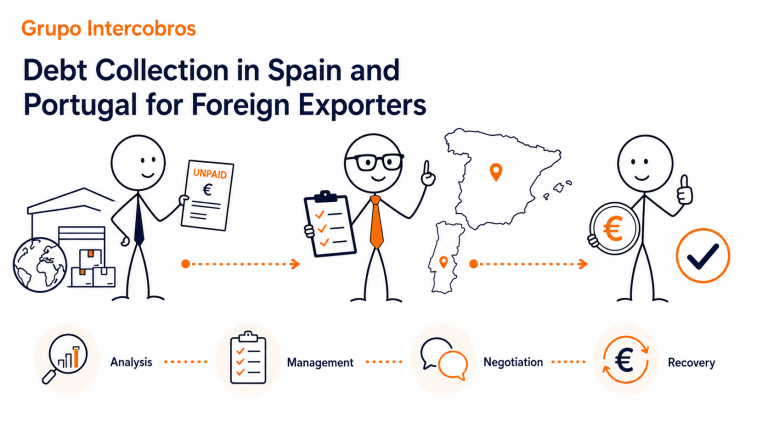
- File analysis. Document verification, age of the debt, registry status and apparent solvency of the debtor. Before calling, you need to know who you are calling and with what real margin.
- Locating the decision-maker. Whoever answers the phone is rarely the person who decides on payment. Identifying the actual decision-maker is half the work.
- Formal demand. Principal, accrued statutory interest and recovery costs, with the applicable national legislation expressly cited.
- Negotiation. Escalating, sustained contact. The objective is a dated commitment, not a vague promise.
- Settlement. Single payment or documented instalment plan, with acknowledgement of debt where appropriate. A signed acknowledgement radically strengthens the position if court action follows.
- Monitoring. An unsupervised agreement is a postponed default. Every instalment is tracked and every breach reactivated immediately.
Across the B2B portfolios we manage in Portugal, the out-of-court recovery rate stands at 77%. That is proprietary Grupo Intercobros data covering business-to-business files handled at the amicable stage. It is not a sector average and not a guarantee: outcomes depend on the age of the debt, the debtor's real solvency and the quality of the documentation.
Going to court: Spain's monitorio and Portugal's injunção
Both countries offer a fast-track route to an enforceable title without a full trial, provided the debtor does not contest the claim.
Spain: proceso monitorio
The creditor files a claim supported by documentation evidencing the debt. The debtor is served and has a limited period to pay, oppose or remain silent. If the debtor stays silent, the creditor obtains an enforceable title and can proceed to attachment. There is no upper monetary limit.
Portugal: injunção
Filed electronically through the Balcão Nacional de Injunções, a single national body based in Porto with exclusive competence. The debtor has 15 days to pay or oppose. If neither happens, the fórmula executória is affixed and the document becomes an enforceable title.
Court fees are expressed in Units of Account and start at 0.5 UC, rising in bands according to the amount claimed. Because the fee does not scale proportionally with the debt, the instrument is particularly efficient for medium and high-value claims. In B2B commercial transactions, there is no monetary ceiling.
One procedural detail surprises foreign creditors: at the filing stage, documentary evidence is not required. The facts are stated. Evidence becomes decisive only if the debtor opposes.
If the debtor opposes
In both jurisdictions, opposition converts the matter into contested litigation, with costs, evidence and delay. This is where documentation becomes decisive: purchase order, delivery note, proof of delivery and invoice must be internally consistent. An inconsistent document chain is the single most common reason a defence succeeds.
This is also why sequence matters. A debtor who has already acknowledged the debt in writing, or accepted and then breached a payment schedule, has very little room to sustain a credible opposition. The amicable phase is not an alternative to litigation. It is the preparation of it.
Enforcement: from title to actual payment
Obtaining an enforceable title is not the same as being paid. It is the right to enforce.
In Portugal, enforcement is driven by an agente de execução, a figure with broad powers to locate assets, order attachment and manage the sale of attached property. In Spain, enforcement runs through the court with equivalent asset-tracing mechanisms.
Attachable assets include bank balances, receivables owed to the debtor by third parties, vehicles, stock and real property. In practice, bank account attachment produces the fastest result where funds exist. Where the debtor has no assets, enforcement exhausts itself without recovery — which is precisely why solvency should be assessed before proceedings begin, not after.
Limitation periods: Spain and Portugal differ sharply
This is one of the few areas where the two systems diverge significantly.
- Spain: the general limitation period for personal actions is five years.
- Portugal: the ordinary limitation period under the Civil Code is twenty years, with shorter presumptive periods in specific cases.
The practical conclusion is the same in both, though. A claim that has not lapsed is not the same as a debt that can still be collected. Recovery probability falls sharply with the age of the file. A company with liquidity problems today may have closed, been absorbed or stripped its assets within two years. The right survives; the money does not.
Warning signs your Spanish or Portuguese customer is about to default
The best recovery is the one that never becomes necessary. These signals typically precede a default by months:
- Drifting payment patterns. Thirty days becomes forty-five, then sixty, always with a reasonable explanation.
- Unsolicited partial payments. Designed to keep the relationship alive without clearing the balance.
- Quality disputes that appear only at due date. Never at delivery. That is not a dispute; it is a delaying tactic.
- A contact who stops confirming anything in writing and only calls. They are building a defence.
- A sudden increase in orders from a customer already carrying overdue balance.
- Registry changes: new registered address, new director, new company name.
No single signal is disqualifying. Two or more together justify requesting advance payment, a guarantee, or reducing the credit limit.
How to protect yourself before you invoice
Verification and contractual discipline prevent most avoidable losses. Six measures worth building into your export process:
- Obtain the legal identifier. CIF in Spain, NIPC in Portugal. Both commercial registries are public and consultable online from abroad, and both will tell you whether the entity is active, dissolved or struck off.
- Check whether accounts are filed. A company that has stopped filing annual accounts is either in difficulty or has stopped attending to its formal obligations. Neither is good news for a supplier extending credit.
- Agree the payment term in writing. Silence means the statutory default applies, which may not be what you intended.
- State interest and recovery costs expressly in your terms, even though they accrue automatically. It removes the argument.
- Keep the document chain consistent. Order, confirmation, delivery note, proof of delivery and invoice must match. This is what decides contested cases.
- Stagger credit. Advance payment or limited amounts on early orders, expanding progressively based on actual payment behaviour. And set a per-customer exposure limit you respect even when the customer asks for more.
What to prepare before instructing a collection agency
- Full legal identification of the debtor, including CIF (Spain) or NIPC (Portugal).
- Unpaid invoices with issue and due dates.
- Purchase order, contract or written confirmation evidencing the commercial relationship.
- Delivery notes or proof of delivery or performance.
- Customer account statement, including any partial payments.
- History of prior demands: emails, letters, minutes — particularly anything in which the debtor acknowledges the amount or proposes a schedule.
That last point is the most undervalued. An email from the debtor requesting more time is worth more than three registered letters. It is a tacit acknowledgement of debt and it largely closes off a defence based on disputing the amount or the quality of supply.
If some of these are missing, the file is not lost. Much can be reconstructed, and what cannot be is offset by reinforcing other elements. We tell you which is which before you commit to anything.
The Client Area: full visibility over a process happening abroad
Cross-border recovery carries a cost that never appears on an invoice: uncertainty. Weeks without news, emails asking how things are going, the feeling of having handed a file into a black box in a country whose language and legal system you do not follow.
Our Client Area exists to remove that. You log in with your own credentials and see, in real time:
- The status of every file, debtor by debtor, across your whole portfolio.
- Every action taken, with its date and its outcome — calls, letters, formal demands, negotiations.
- The stage each claim has reached: amicable, formal demand, court filing, opposition or enforcement.
- Amounts recovered and amounts outstanding, per debtor and in aggregate.
- All documentation associated with the file, in one place.
- Portfolio-level reporting, so management can see the position without requesting a report.
It is available through any browser and as an iOS and Android application, so you can check the status of your Spanish or Portuguese receivables from a phone, at any hour, without calling anyone or waiting for a time zone to align.
There is a secondary effect clients value more than they expected: the Client Area eliminates follow-up calls entirely. Your finance team stops spending time asking for updates because they simply look. In international recovery this matters more than anywhere else — when the process happens in another country, in another language, visibility is what replaces control.
Above the platform sits your assigned client account manager: a single, consistent point of contact linking your company to the collections team, handling everything the platform does not cover. You are not passed from hand to hand or asked to repeat your history on every call. For larger portfolios, they also coordinate regular review meetings with your teams.
Working with Grupo Intercobros
We are a B2B extrajudicial debt recovery firm headquartered in Madrid, with offices in Barcelona and Seville, operating directly in Spain, Portugal, France and Italy. You can see the full scope on our international debt collection page, and the step-by-step process on how it works.
Amicable recovery first
Litigation is expensive, slow and uncertain. We exhaust negotiation before recommending court action — and when we do recommend it, the amicable phase has already built the documented file that makes the claim hard to contest.
Success-based fees
We charge only if we recover. No retainers, no opening fees, no fixed costs. The percentage is assessed case by case, according to the debtor's country and the characteristics of the portfolio.
An honest assessment first
Before anything is agreed, we analyse your portfolio and tell you what we think is recoverable and what is not. If we believe a file will not produce a recovery, we say so rather than take it on.
Frequently asked questions
Can a foreign company recover a debt in Spain or Portugal without a local entity?
Yes. Out-of-court recovery requires no local presence, no travel and no local company. The negotiation is handled by native collectors in the debtor's country, and the creditor is kept informed from abroad through the Client Area and an assigned account manager.
What interest can I claim from a Spanish or Portuguese debtor?
In commercial transactions, late payment interest accrues automatically from the day after the due date, with no reminder required, under Ley 3/2004 in Spain and Decreto-Lei n.º 62/2013 in Portugal. In Spain the statutory rate is the ECB main refinancing rate plus eight percentage points. Both countries also provide a fixed minimum of 40 euros in recovery costs.
What is the statutory payment term in Spain and Portugal?
Where nothing is agreed, interest accrues 30 days after receipt of the invoice in both countries. Agreed terms should not, as a general rule, exceed 60 days, and terms that are grossly unfair to the creditor may be set aside.
How long do I have before the debt becomes time-barred?
The general limitation period for personal actions is five years in Spain. In Portugal the ordinary period under the Civil Code is twenty years, with shorter presumptive periods in specific cases. In practice, recovery probability falls sharply with the age of the file, so acting within the first months after the due date matters far more than the formal deadline.
Do I need a lawyer to start court proceedings?
Not necessarily at the initial stage of the fast-track procedures. In Portugal an injunção may be filed by the creditor, a lawyer or a solicitador. Legal representation becomes necessary if the debtor opposes and the matter moves to contested litigation, depending on the amount and the procedural route.
Is there a minimum or maximum amount you will handle?
What matters is the portfolio rather than the individual invoice. Where several files relate to the same debtor, or where there is an aggregated volume of unpaid invoices, recovery is fully viable. We assess the whole portfolio before recommending a strategy.
How long does recovery take?
At the amicable stage, first results typically appear within the first weeks and settlements are usually agreed within the first months. Court routes are slower and depend on whether the debtor opposes. In Portugal, an uncontested injunção can be resolved in a matter of weeks from service.
How can I follow the progress of my files?
Through the Client Area, which shows in real time the status of every file, every action taken with its date and outcome, the procedural stage reached and the amounts recovered. It is available through any browser and as an iOS and Android app, and you also have an assigned account manager as a single point of contact.
What does it cost?
We work on success-based fees: we charge only if we recover. There are no retainers or opening fees. The percentage is assessed case by case, according to the debtor's country and the characteristics of the portfolio.
What if the debtor claims to have no assets?
Apparent insolvency is rarely definitive and is one of the most frequently used excuses. It should be verified rather than accepted, through the commercial registry, filed accounts and the debtor's actual behaviour during negotiation. Where insolvency is real, the claim can be kept alive so that enforcement can be reactivated if the debtor's position improves.
Do you also cover France and Italy?
Yes. We handle B2B extrajudicial recovery in Spain, Portugal, France and Italy, with in-house native collectors in each market. Portfolios spread across several countries are assessed together.
Can I write to you in English?
Yes. You can submit your case and your questions in English through our contact form, and we will come back to you.
Sources and legislation
- Ley 3/2004 — measures against late payment in commercial transactions, Boletín Oficial del Estado, Spain.
- Decreto-Lei n.º 62/2013 — late payment in commercial transactions, Procuradoria-Geral Distrital de Lisboa, Portugal.
- Injunção procedure — Citius portal, Portuguese Ministry of Justice.
- Court fees in Portugal — European e-Justice Portal.
- Portuguese commercial registry services — gov.pt.
Send us your unpaid invoices
If you are exporting to Spain or Portugal and have overdue invoices, the first step costs nothing. We analyse your portfolio free of charge and tell you frankly what is recoverable, on what timescale and with what strategy. If we believe something cannot be collected, we will say so.
From there, success-based fees: we charge only if we recover. No retainers, no opening fees. And you get an assigned client account manager plus full real-time visibility through the Client Area.
The single most important variable is timing. Every month that passes reduces the probability of recovery, so the sooner a file reaches us, the better the outcome tends to be.
Submit your case through our contact form — you are welcome to write to us in English.